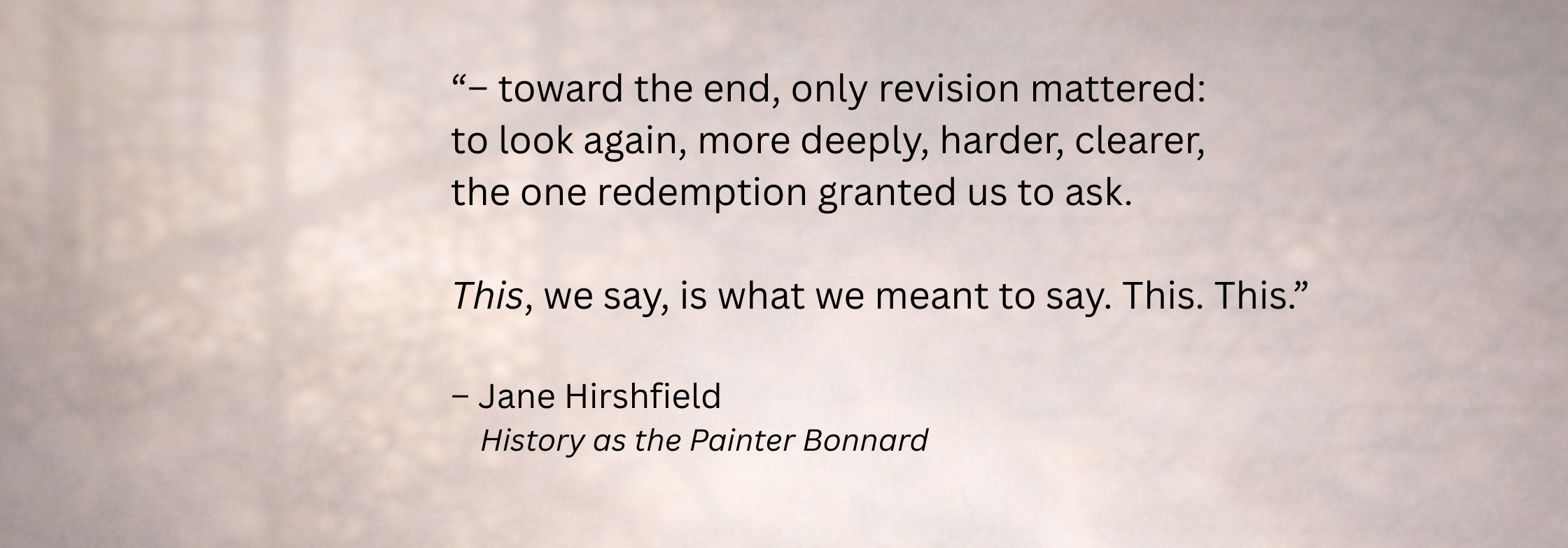
To Look Again is a 4 month certificate program that brings playfulness, curiosity and rigour to the act of revision. We treat revision not as an add-on or an extra, but as an essential part of the creative process. We honour rewriting as the place where much of the work of creativity happens— not in a burst of inspiration or genius, but in the dogged return to the page, refining and deepening our original visions.
Just as importantly, we treat revision — the art of looking again at our stories and our feelings — as an important life skill. We draw upon principles from Narrative Therapy, and we play with reframing and reimagining our own narratives, the stories we tell about ourselves to ourselves. We work with what becomes visible when we have the courage to return, to ask new questions, to look again and more deeply.
Over the four months of this course, you will learn how to revise with honesty and precision. You will learn the art of “re-looking,” of seeing the familiar with fresh eyes, because that is where insight, craft, and meaning reside. You will learn to go deeper into your work and your worldview, become more authentic in your expression, and find more joy in the work of creativity. Whether you are working in poetry, in memoir, or in fiction, the goal during this course will always be to bring fresh eyes and new insight, to your writing and to your life.
Most importantly, you will leave writing and rewriting pieces that will change your life — because how else will they change anyone else’s?
Dates: 21 February 2026 - 27 June 2026
Cost: Rs. 48,000 per person
A limited number of scholarships based on financial need are available. Make sure to mention it in your application if you would like to participate but cannot afford the fee.
Please note that this is not a therapy group, and I am not a therapist. The program is informed by my intensive study of Narrative Therapy, as well as my experiences working alongside therapists for nearly a decade, but this is still very much a writing workshop rather than a group therapy experience. The words you write here will enable some kind of healing and catharsis, even discovery and growth towards new possibilities, but our focus will remain on the words themselves. If you think you might need additional mental health support to navigate the program, please reach out to me, and I will connect you to therapists as well.
Registrations Open: 8 January - 8 February, 2026.
Applications will be accepted on a rolling basis, and once the seats are full, no more applications will be considered.
COURSE COMPONENTS
-
We will meet every Saturday from 10:30 AM to 1 PM. Twice a month, these sessions will be used for manuscript critique and workshopping, and the other sessions will be distributed between reading groups and workshops with guest faculty.
-
In addition to our live workshops, you will also get access to an instructional video every other Monday. These videos will take you through particular element of the craft of revision, and each video will culminate in a writing exercise intended to practise the craft element in question. You can return to these videos for the duration of the course, debrief them in our Zoom calls, and have an ongoing conversation about them in the comments.
-
We alternate weeks between focussing on Craft and focussing on the Narrative Therapy inspired components of this program. In the weeks when you are not working through a craft video, you will receive a writing prompt or guided exercise that uses the frame of “re-vision” to explore your own life and the stories you tell yourself. The goal of these exercises is to generate fresh writing and to support you on a journey of re-framing, healing, self-discovery, and celebration. You will always have a space in which to share these, but you will never be forced to do so.
-
I am bringing in several guest faculty members to maximise what you will gain from this program. Akhil Katyal will work with you on revising poetry and thinking about the role of research in revision. Tanuj Solanki will share his process for long-form revision, particularly int he context of fiction. Natasha Badhwar will think alongside you about the ways in which writing and rewriting memoir shape memory and meaning. Dharini Bhaskar will share her process as a novelist but also as a senior editor working on her own as well as other people’s first drafts. Arpita Das will do a workshop specifically on editing and also talk about the world of independent publishing. And Rahul Soni will help you all think through literary journals, submitting your work to agents or big publishing houses, and other things to keep in mind when revising for a larger public. I cannot tell you how excited I am about this list: They are each independently amazing at what they do, and I feel so honoured to be able to bring them all together for you.
-
Each participant of the course will get two individual sessions of 30 minutes each to work with me on questions, clarifications, hopes and dreams, and where you want to go with your work. The sign up sheet for these will be shared in the first week of the program.
-
Every week, you will be expected to turn in a short process journal, based on questions taken from Narrative Practices, so that you can begin developing a reflexive artistic practice, where you learn and grow from all of your experiences and struggles. Your peers and instructors will have an opportunity to reflect on and respond to these learning journals.
-
Twice a month, we will spend the bulk of our Zoom calls doing in depth critique of 3 students’ work using the Liz Lerman Critique process. In the process, you will not only get insights into your own work, but much more importantly, you will learn how to think about, revise, and edit poetry. Once we have practised the skill of offering useful critique for a few weeks, there will also be an ongoing discussion space for you to continue this process with peers as regularly as you would like.
-
“To Look Again” is located within The Make Space, a larger community I run for artists and writers. This means you will have access to ongoing discussion forums, chat rooms, and spaces to exchange work with your peers in this poetry course, as well as access to larger community events, including co-working sessions, additional workshops, and more.
-
On one hand, this course is not structured assuming everyone who wants to write also wants to publish. On the other hand, I am aware that publishing is something that a lot of writers aspire to, especially as they get deeper into craft and revisions. While we have not set aside specific sessions for publishing, we do have three guest faculty with extensive experience working in big as well as independent publishing houses, and I’m also happy to share my own insights and experiences in this regard. If you want to send focused time thinking about publishing, bring it up in our one-on-ones as well!
-
By the end of the program, you will have written and edited a signifiant number of pieces, and we will all have witnessed one another on a powerful writing journey. We shall close with a graduation reading online, to which you can bring friends and family.
Frequently Asked Questions
-
For the foreseeable future, this program is completely online, mostly because it spans several months and includes guest faculty who are spread out all over the country! I will continue to offer shorter 4-5 day workshops and offline retreats, but I do not imagine being able to replicate the breadth and depth of this program in an offline space.
-
No. I have worked in therapy-adjacent spaces for years, such as leading youth groups alongside a team of therapists, and I have completed the South Asian Diploma in Narrative Practices. However, I am not a therapist myself, and I do not claim for this to be a therapy group. I am simply using ideas, approaches, and exercises inspired by Narrative Therapy to take you deeper into your own journeys of growth and healing, as well as deeper into your writing.
If you find you need additional mental health support as you work your way through this program, I am happy to recommend therapists to you. -
No, you don’t. You ideally need some older writing that you are ready to look at with fresh eyes, but this doesn’t need to be a full manuscript— a few poems, part of a story or essay, all of that will work.
If you are absolutely new to writing, you can still take part and will gain some useful skills along the way— there’s nothing like starting your writing journey with the flexibility and rigour of revision! However, you may in some cases be doing extra work then, where you write an early draft and then rework it from a different lens. -
On an average, plan on spending 5-7 hours a week on coursework, which includes the 2.5 hours of our weekly Zoom call, watching and responding to the weekly video or writing exercise, and engaging with the other activities on the channel. You could definitely spend a lot more time reading and responding to one another if you like, but this would be a good ballpark from which to begin.
-
I do ask for writing samples because it helps me gauge where everyone in the program is at, but I do not use them as a metric for whether you will be accepted to the program. This program is a space for growth, and I’m not invested in gatekeeping based on where you currently are in your writing. Feel free to leave out the writing sample from your application if you are worried about this part.
-
Over our four months together, we will work on revising your drafts, sharpening your voice, and editing your work with more clarity. You’ll also learn from three guest faculty with deep experience in editing and publishing. So while we cannot guarantee publication, and this isn’t a course about getting published, it will certainly help move you in that direction if you want to go there.
-
In general, I highly encourage you to be there for all the sessions because I do not work in a simple lecture format but instead focus on peer learning and discussions. However, over the course of the four months, I do expect your life to continue to happen, and it’s totally okay if you miss a session due to illness or emergencies. We will, as far as possible, share recordings of workshop sessions so that you can catch up on what you miss.
-
Unfortunately, no. Learning to write well takes time, and learning to trust a group enough to write with authenticity and honesty in their midst takes even longer. The program is intentionally long so that you have a chance to really delve deep into the work we are doing together and individually, so I’m afraid it is all or nothing here.
-
All participants who attend at least 75% of workshop sessions and turn in at least 75% of the assignments will, on request, receive a Certificate of Completion.
-
Yes! If you want to join us but cannot afford the full fee, please include this information in your application form. I may not be able to offer you a full waiver, but I do my best to accommodate every writer, regardless of ability to pay.
Registrations Open: 8 January - 8 February, 2026.
Applications will be accepted on a rolling basis, and once the seats are full, no more applications will be considered.
TESTIMONIALS
“I can say without hyperbole that Aditi’s workshop has been one of the most transformative spaces for me as a writer. It was where I learned to build my writing, in community, with Aditi as an instructor. “
Urvashi Bahuguna, Author of “Terrarium” and “No Straight Thing Was Ever Made”

“Aditi’s workshops have made me feel safe enough, held enough, and connected enough to write about traumatic and difficult things I would not have been able to write about in isolation.”
Kuhu Joshi, Poet and Professor, Author of “My Body Didn’t Come Before Me”
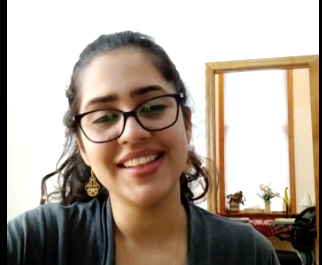
“I did Aditi’s writing workshops twice, and I think it’s the most transformative thing anyone can sign up for.”
Aishani Khurana, PhD Scholar

“Aditi’s workshops changed my life, personally and professionally. Not only did I find my voice but I also found many wonderful writing partners.”
Kandala Singh, MFA Candidate at University of Pittsburg
About the Facilitator
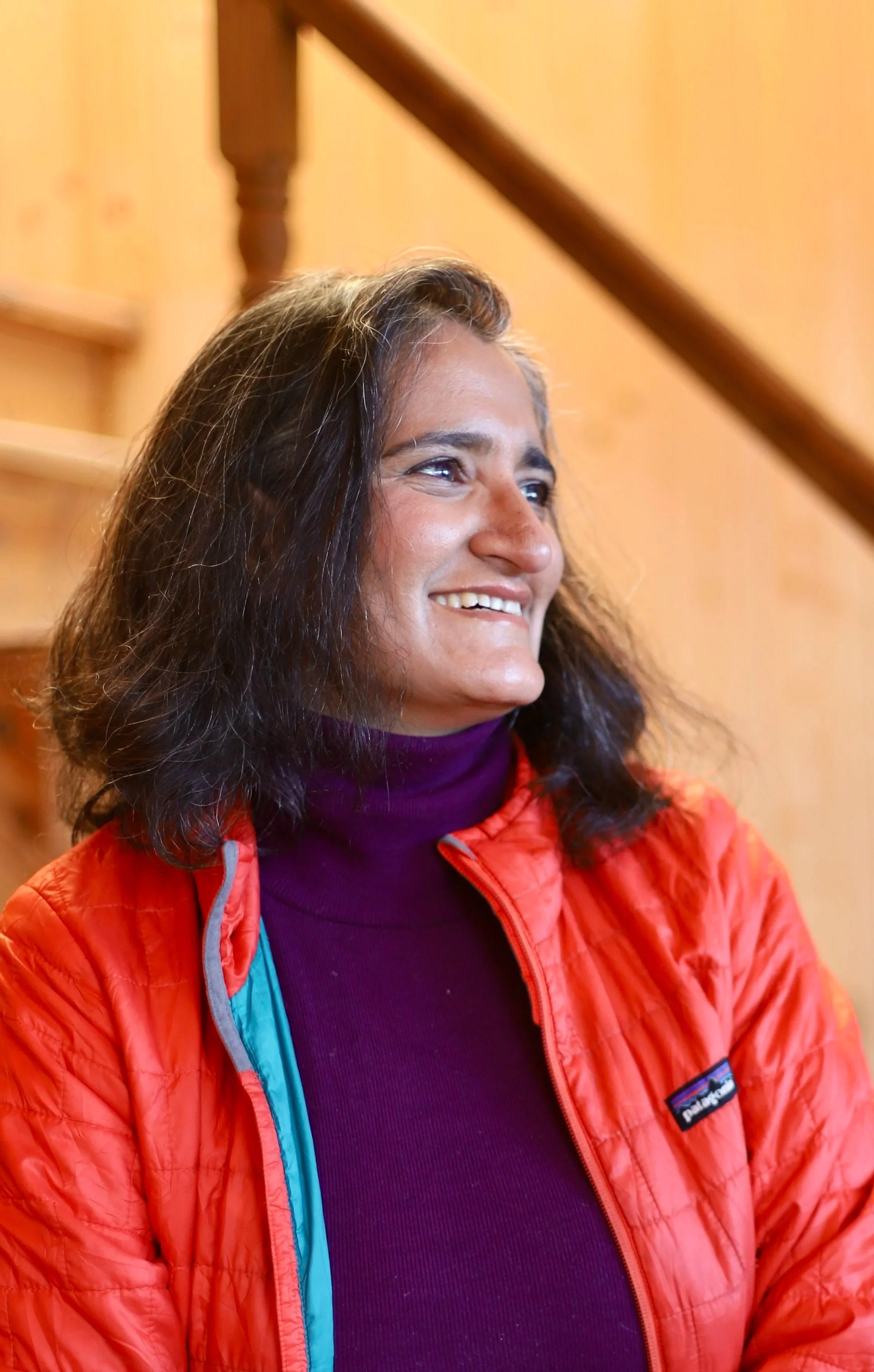
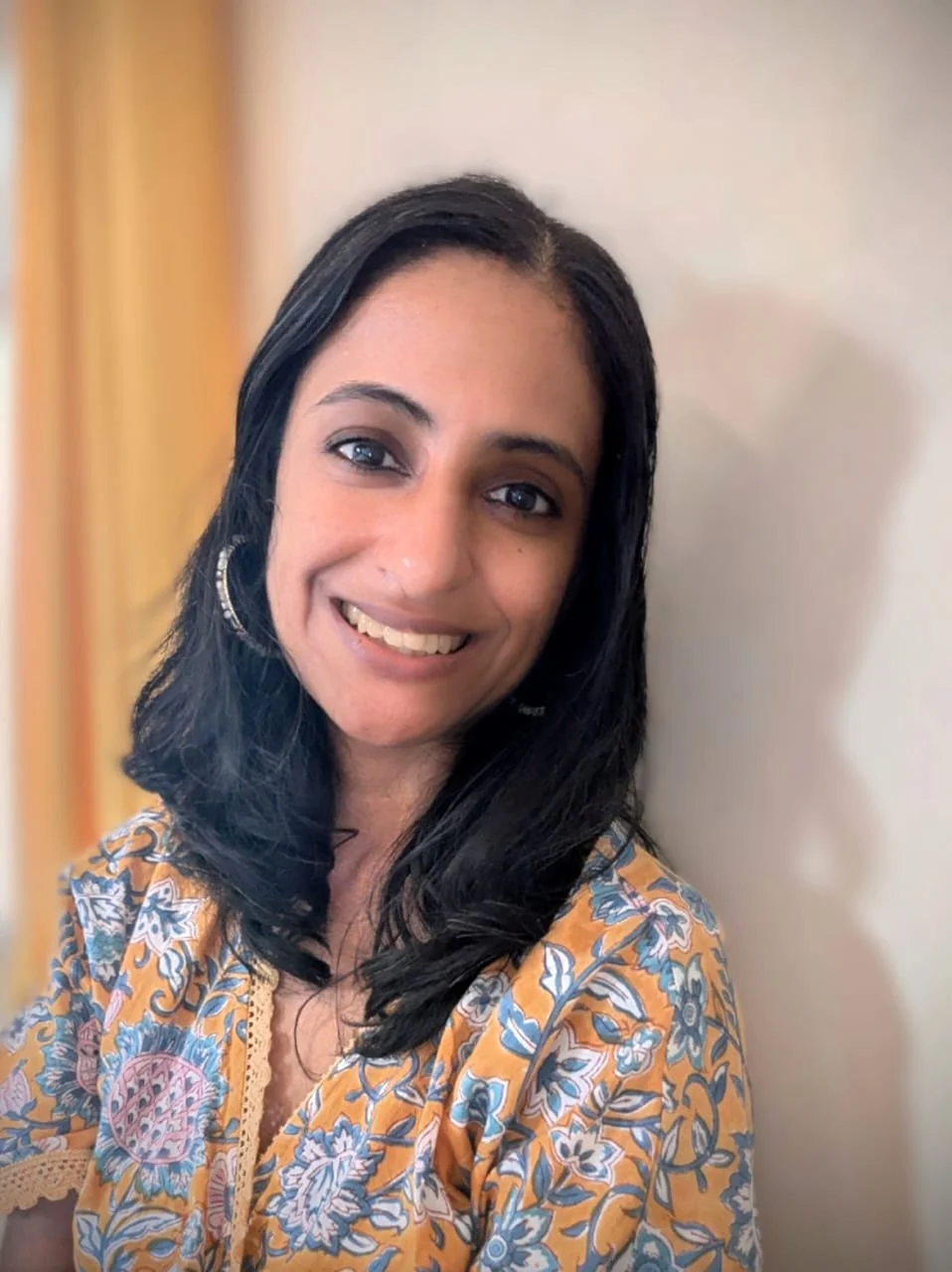
Aditi Rao
As a writer, I’ve published two full length collections of poetry, The Fingers Remember (Yoda Press 2014) and A Kind of Freedom Song (Yoda Press 2019), and my first non-fiction book will be published by Harper Collins in 2026.
My poems and essays have been published widely, and my work has received national and international recognition through awards and fellowships, including the Akademie Schloss Solitude Fellowship, the Hedgebrook Residency, the Sangam House International Writers’ Residency, the Srinivas Rayaprol Prize for Poetry, the TFA Creative Writing in English award, the Muse India – Satish Verma Young Writer Award, and others.
I have been teaching creative and research writing for two decades, independently as well as in institutional and university settings. I have also trained and worked as a facilitator in Youth Development and Peace Education contexts, with organisations across India, Mexico, the United States, and Nepal. I also work as Creative Director of the Nomad Eco-Retreat and co-founder of the Serai Residency.
I have an MFA in Creative Writing from Sarah Lawrence College. I have also completed a certificate in Conflict Transformation and Peacebuilding from the School of International Training, Vermont, and the South Asian Diploma in Narrative Practices and Ideas from Narrative Practices India, both of which inform the ways in which I teach and foster community.
Over the last twenty years, I’ve helped hundreds of people tell their stories, find their voices, and create meaningful writing communities. I pride myself not only on the awards, publications, and other professional accomplishments of many workshop alumni, but also on the ways in which I’ve seen participants grow confident in their stories, find the courage to write authentically, and cultivate writerly friendships that have lasted for years after. I can’t wait to welcome more of you into that fold.
Guest Faculty
To Look Again will be made richer and deeper through the insights and experiences of a fantastic range of writers, teachers, and editors, and I’m so excited to see what we can all build together that none of us could do alone. All of the faculty members below will have at least one 2-hour workshop session, focused on different genres of writing as well as different parts of the editing and publication process.
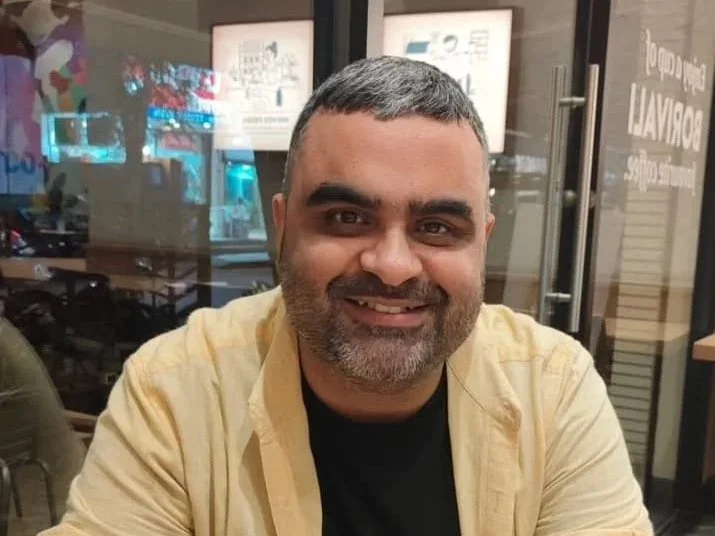
Akhil Katyal
Akhil Katyal is the author of 'The Last Time I Saw You' (Harper Collins India) and 'Like Blood on the Bitten Tongue: Delhi Poems' (Westland-Context). He has co-edited 'The World That Belongs to Us: An Anthology of Queer Poetry from South Asia' (HarperCollins India) and has translated Ravish Kumar's 'Ishq Mein Shahar Hona' as 'A City Happens in Love' (Speaking Tiger).
He has previously held the University of Iowa International Writing Fellowship and the Vijay Nambisan Poetry Fellowship.
He is the Associate Professor of Literature at the BITS LAW School where he also directs the Writing Centre. He lives in Mumbai.
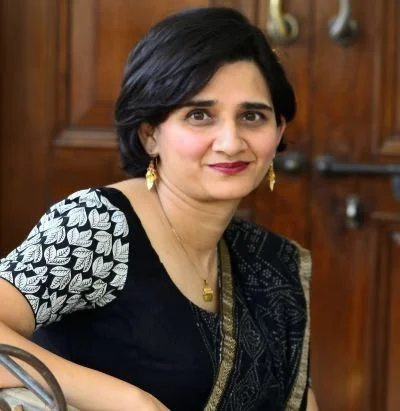
Natasha Badhwar
Natasha Badhwar is an award-winning film-maker, author and creative writing coach. Her courses include memoir and creative writing at Ochre Sky Workshops and film and writing courses at Ashoka University.
Natasha has received the Laadli Media & Advertising Award for Gender Sensitivity in 2016 for a cover feature published in The Hindu. In 2022, she received the Laadli Media award in the web documentary category for her documentary film, Pins and Needles, that highlights the struggles and resistance of women workers in the garment industry in Gurgaon.
Natasha started her career as one of India’s first women camerapersons in news television with New Delhi Television (NDTV). She worked across departments as a video journalist, documentary film-maker, editor and trainer and rose through the ranks to become Vice President, Training and Development. A popular columnist, Natasha has written consistently for Mint Lounge, BBC Hindi, The Tribune, The Hindu, Indian Express and The Morning Context. She is the author of the books My Daughters’ Mum and Immortal For a Moment, published by Simon & Schuster, India. With Harsh Mander and John Dayal, she has co-authored Reconciliation, Karwan e Mohabbat’s Journey of Solidarity Through a Wounded India, published by Westland Books. With Harsh Mander and Anirban Bhattacharya, Natasha has co-authored When The Mask Came Off – Lockdown 2020: A People’s History of Cruelty and Compassion, published by Yoda Press.
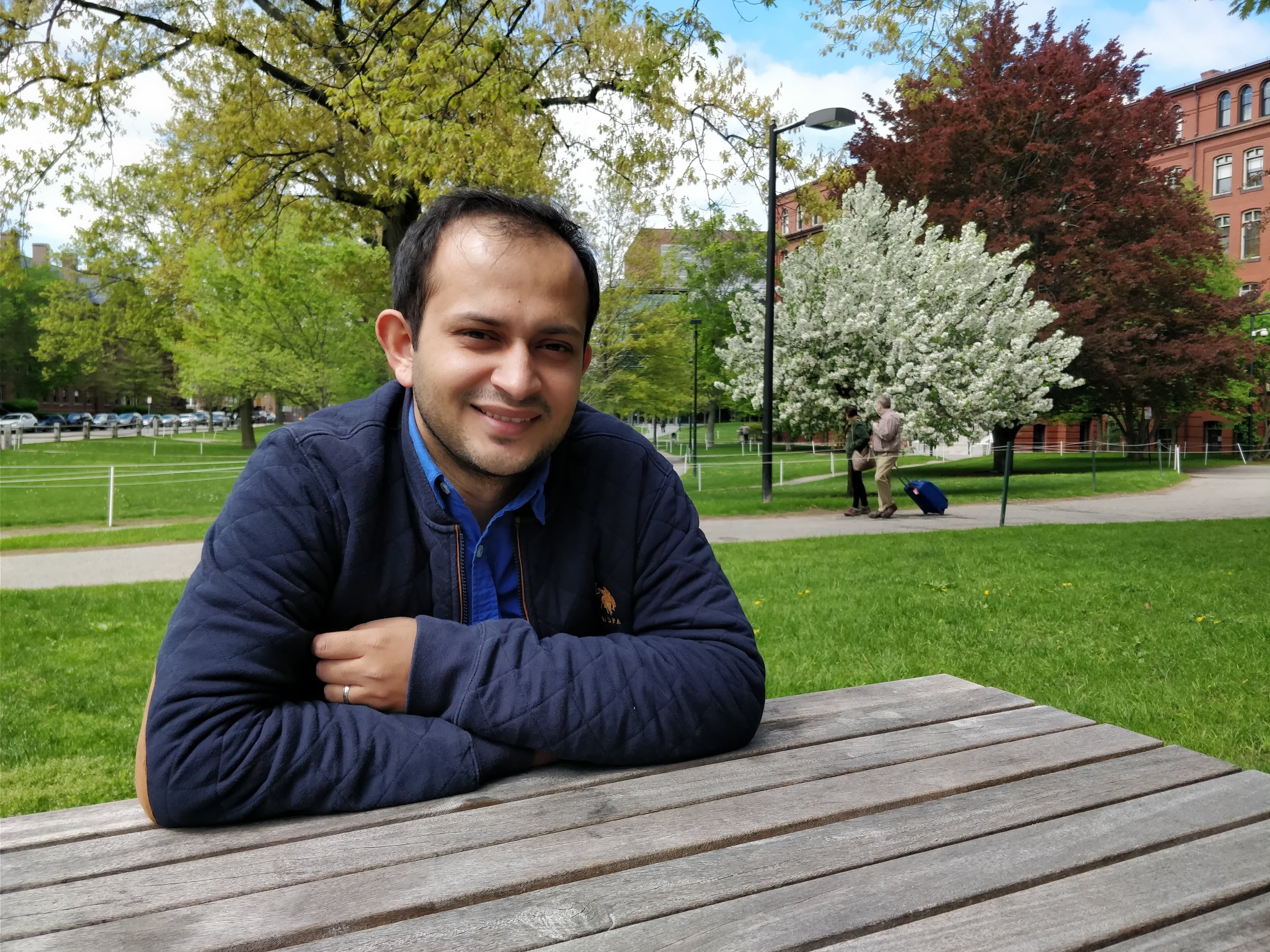
Tanuj Solanki
Tanuj Solanki is the author of four books of fiction.
In 2019, he received the Sahitya Akademi Yuva Puraskar for his short-story collection, Diwali in Muzaffarnagar. His last two novels, The Machine is Learning and Manjhi’s Mayhem, were both longlisted for the JCB Prize for Literature.
Tanuj’s work has appeared in numerous Indian and international magazines of repute. He is also the founder and fiction editor of The Bombay Literary Magazine.
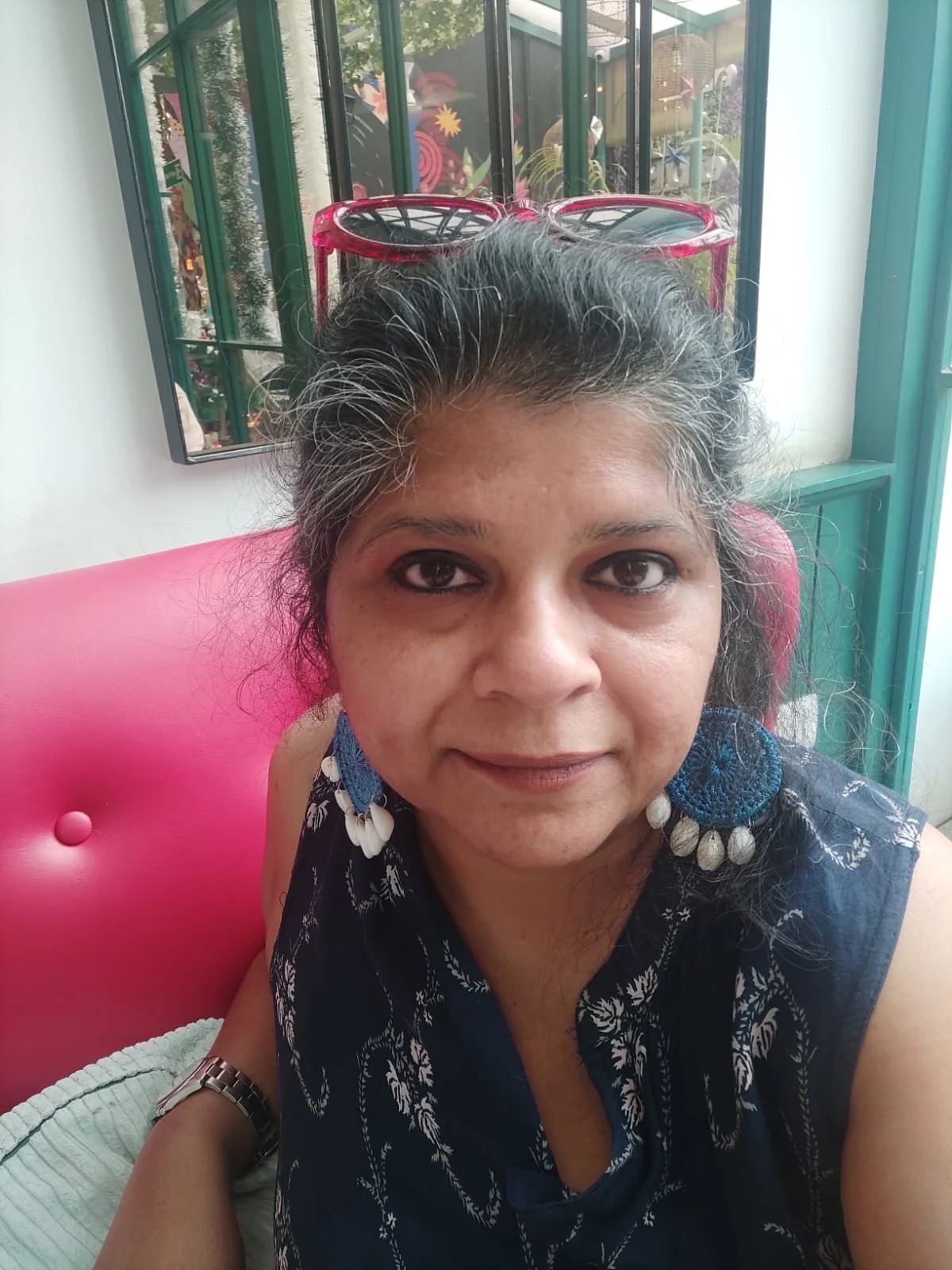
Arpita Das
Arpita Das is the Founder-Publisher of the award-winning independent publishing house based in New Delhi, Yoda Press.
She is Associate Professor of Writing at Ashoka University, where she teaches the Publishing Seminar to senior students of Creative Writing at Ashoka University and two Foundation Courses called Introduction to Critical Thinking and Great Books to first-year students.
In the past, she helped set up the Word Lab at the Indian Institute of Human Settlements in Bangalore, and led the Sage School of Publishing courses at various universities and institutions across India. She contributes a regular column to the New York-based trade journal, Publishing Perspectives. She is also the Editor of the South Asia Series at Melbourne University Publishing
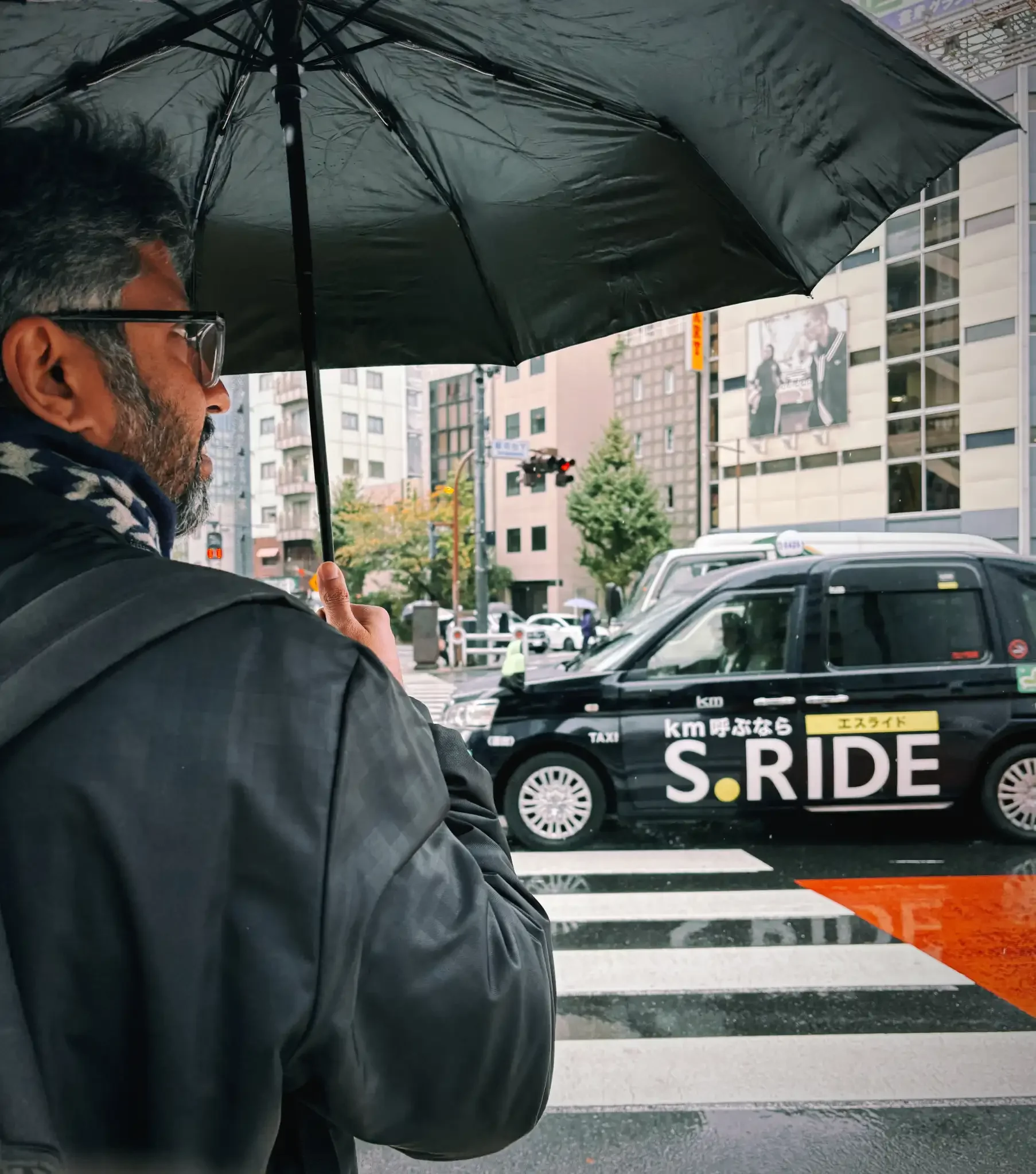
Rahul Soni
Rahul Soni is a writer, translator, and Editor-at-Large at HarperCollins India.
He has acquired and edited books that have gone on to become among the best-known literary works of recent years, and have won every major award in India, as well as winning or being shortlisted for major international awards including the Booker Prize for Fiction, the JCB Prize for Literature, the DSC Prize for South Asian Literature, the International Dublin Literary Award, the Pulitzer Prize, the Women’s Prize for Fiction, the National Translation Award (ALTA), the PEN/Faulkner and PEN/Nabokov awards, The Center for Fiction First Novel Prize, etc. In 2020, he won the Editor of the Year Award presented by Publishing Next, the only industry award for the book trade in India.
As a translator, his work includes Magadh by Shrikant Verma, Dopehri by Pankaj Kapur, and The Roof Beneath Their Feet by Geetanjali Shree. His writing and translations have appeared in Granta, The Poetry Review, and The Times Literary Supplement.
He is also the founding editor of South Parade, a journal of literature from the Global South.
Dharini Bhaskar
Dharini Bhaskar is the author of two novels. Her debut, These, Our Bodies Possessed by Light (Hachette India), was shortlisted for the JCB Prize for Literature, the Tata Literature Live! First Book Award (Fiction), and the Valley of Words award. Her second novel, Like Being Alive Twice (Penguin Random House India), was longlisted for the 2024 Ruskin Bond Award for Fiction and featured in several most-anticipated lists including Vogue and Open Magazine.
Her short fiction has appeared in Day’s End Stories and The Only City: Bombay in Eighteen Stories (Fourth Estate/HarperCollins), alongside writers such as Jeet Thayil and Shubhangi Swarup. She has written essays and columns for The Hindu BLink, Mint Lounge, Arre, Firstpost, Vogue, and The Free Press Journal.
Dharini spent over a decade in publishing and is currently Associate Publisher, Literary, at HarperCollins India. She lives in Bangalore with her son, with whom she shares a love for painting, backpacking, and long bike rides.